SciMed
Prism Bar Set — Horizontal + Vertical Loose Prism Bars in Case, Strabismus + Vergence Measurement
Prism Bar Set — Horizontal + Vertical Loose Prism Bars in Case, Strabismus + Vergence Measurement
Couldn't load pickup availability
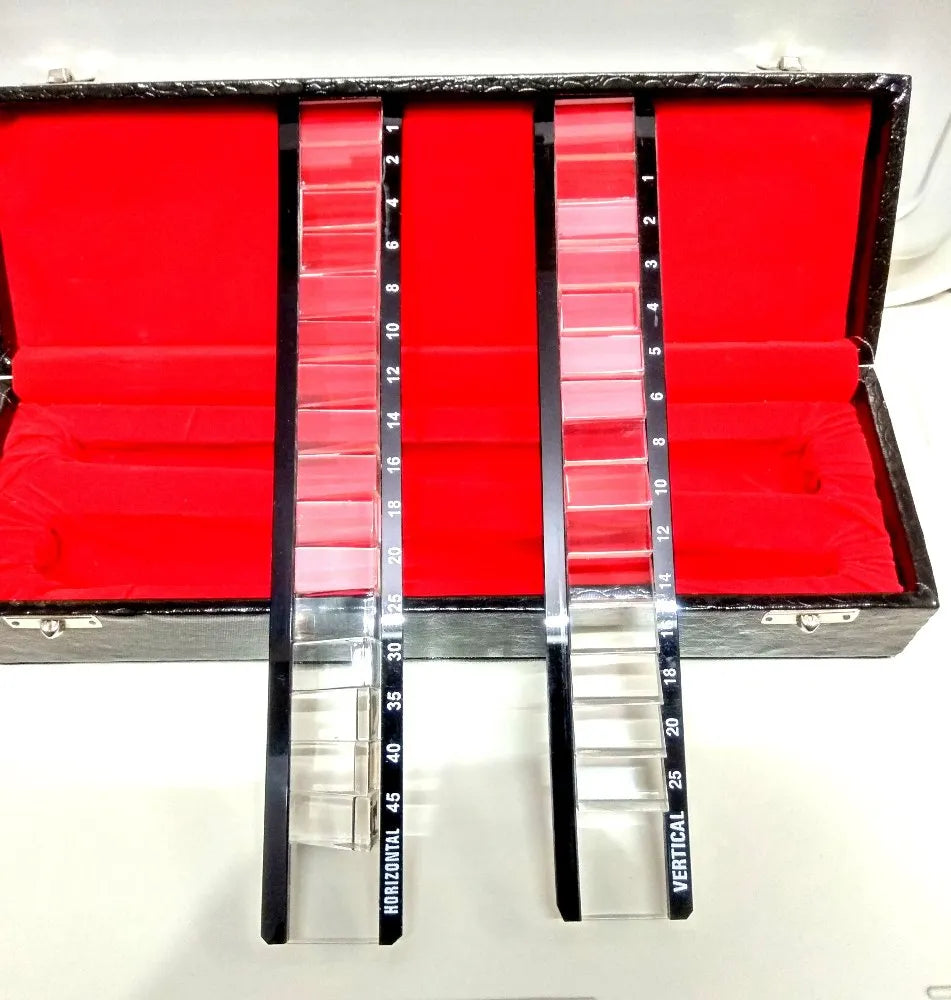
Ophthalmic prism bar set — horizontal + vertical loose prism bars for measuring strabismus, phorias, vergence facility, and fusional reserves. Horizontal bar covers 1-40 prism diopters (1/2/4/6/8/10/12/14/16/18/20/25/30/35/40Δ) for esotropia + exotropia measurement. Vertical bar covers 1-25 prism diopters (1/2/3/4/5/6/8/10/12/14/16/18/20/25Δ) for hypertropia + vertical phorias. Comes in protective case. Essential equipment for pediatric ophthalmology, orthoptics, adult strabismus, and vergence dysfunction workup.
Specifications
| Horizontal prism bar | 1 / 2 / 4 / 6 / 8 / 10 / 12 / 14 / 16 / 18 / 20 / 25 / 30 / 35 / 40 Δ (prism diopters) |
|---|---|
| Vertical prism bar | 1 / 2 / 3 / 4 / 5 / 6 / 8 / 10 / 12 / 14 / 16 / 18 / 20 / 25 Δ |
| Prism material | Optical glass (high refractive index, precision-ground) |
| Mount | Handheld — clinician holds bar in front of patient's eye during cover test |
| Case | Padded case protecting both bars during transport + storage |
| Warranty | 1-year against manufacturing defects |
Clinical applications
- Strabismus measurement (prism + alternate cover test) — quantifying esotropia, exotropia, hypertropia in prism diopters
- Fusional reserve testing — measuring positive + negative fusional convergence
- Phoria measurement — heterophorias (latent misalignment) via cover test
- Vergence facility testing — dynamic accommodation-vergence workup
- Pediatric ophthalmology workup — infantile esotropia, accommodative esotropia
- Post-strabismus surgery evaluation — residual deviation quantification
- Orthoptics + vision therapy — baseline + progress measurement
- Diplopia workup — measuring binocular vision defects
- Nystagmus + oscillopsia evaluation
- Pre-op strabismus planning — Krimsky method + prism + cover test
Best for
- Ophthalmology practices offering strabismus + vision therapy
- Pediatric ophthalmology specialists
- Orthoptists + vision therapists
- Optometry practices with binocular vision workup
- Academic ophthalmology + optometry teaching programs
- University orthoptics + optometric technician training
- Community + rural eye clinics
- International eye clinics via DDP
- NGO pediatric ophthalmology + strabismus outreach
Buying for a practice, teaching program, or NGO?
- Volume pricing on 3+ orders — teaching program + multi-clinic + NGO fleets
- Net-30 invoicing for verified optometry / ophthalmology / academic accounts
- SAM.gov / VA compliant — VA pediatric ophthalmology
- Bundle with 4-Mirror Gonioscope + Occluders + Maddox rod for complete binocular vision workup kit
- International DDP shipping — huge pediatric ophthalmology market globally
- NGO pediatric strabismus outreach pricing on 5+ orders
FAQ
How does this compare to Berens or Katena prism bars?
Feature parity on prism diopter values + optical glass grade + case. Berens + Katena have slightly higher polish + tighter tolerance on prism angle QC. Price differential: $300 vs $650-$1,200 for Berens / Katena. For most clinical strabismus measurement, this SciMed set delivers full clinical utility at 30-45% of premium OEM pricing.
Why loose prism bars vs individual loose prisms?
Prism bars keep all diopter values organized in a single handheld device — faster clinical workflow than searching through a case of individual loose prisms. For fine measurement in between bar values (e.g., 17Δ), use bar + loose prism combined.
What's the difference between horizontal and vertical bars?
Prism base direction is what's measured. Horizontal bar (base-out or base-in) measures horizontal deviations — eso/exo. Vertical bar (base-up or base-down) measures vertical deviations — hyper/hypotropia. Both needed for complete strabismus workup.
Share