SciMed
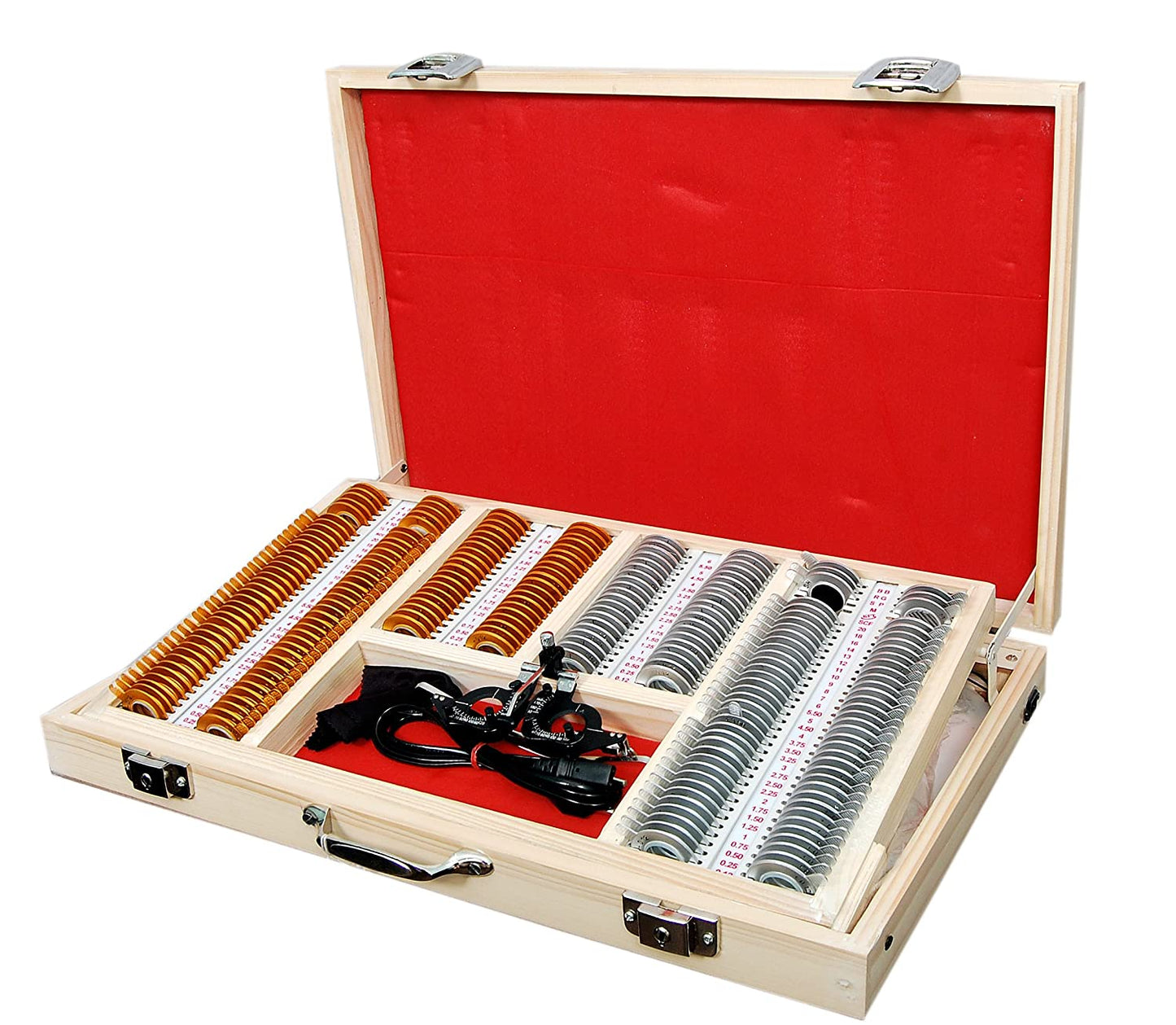
Illuminated Trial Lens Set — 225 Lenses, 20mm Reduced Aperture, Aluminum Mounts, Auto-Rise Tray
Illuminated Trial Lens Set — 225 Lenses, 20mm Reduced Aperture, Aluminum Mounts, Auto-Rise Tray
Couldn't load pickup availability
225-piece illuminated trial lens set — the complete refraction kit for optometry practices, ophthalmology satellite exam rooms, university teaching programs, and eye camps. Extra-white imported optical lenses with 20mm reduced aperture (edge-glare-free viewing), aluminum 38mm-diameter mounts (plus lenses one color, minus lenses another color — instant identification during subjective refraction), handled sphere lenses for easy manipulation, and auto-rising tray with integrated LED backlight controller. Attractive colored acrylic case with double lock. Includes trial frame + case + 1-year warranty. $549 direct — versus $1,500-$3,000 for TopCon / Nidek / Reichert trial lens sets.
Specifications
| Total lenses | 225 pieces (complete set) |
|---|---|
| Sphere range | +/- 20.00 D typical (0.25 D steps in mid-range, 0.5-1.0 D in extremes) |
| Cylinder range | +/- 6.00 D typical (0.25 D steps) |
| Prism range | 0.5 to 10 prism diopters + rotary prism accessory |
| Auxiliary lenses | Pinhole, cross cylinder, red/green filters, occluders, Maddox rod |
| Aperture | 20 mm reduced aperture (edge-glare-free viewing) |
| Mount | Aluminum, 38 mm diameter — universal trial-frame + phoropter compatible |
| Lens material | Imported extra-white optical glass (high accuracy) |
| Power basis | Plano back vertex (standard refraction convention) |
| Color coding | Plus (converging) lenses one color, minus (diverging) lenses another color — instant identification |
| Sphere handles | Yes — handles provided for easy manipulation during refraction |
| Trial frame | Included — standard adjustable adult frame |
| Case | Attractive colored acrylic top with double-lock closure |
| Illumination | Auto-rising tray with LED backlight (opens when lid raised, illuminates lens tray) |
| Warranty | 1-year against manufacturing defects |
Applications
- Subjective refraction — determining patient's optimal correction (sphere + cylinder + axis)
- Retinoscopy verification — confirming objective retinoscopy findings with subjective response
- Spectacle prescription — final Rx determination
- Contact lens over-refraction — verifying contact lens Rx
- Binocular vision assessment — Maddox rod, prism dissociation, phorias
- Low vision assessment — high-power sphere + telescopic magnifiers
- Pediatric refraction — screening + prescription in younger children
- Post-refractive surgery re-refraction — LASIK, PRK, corneal transplant follow-up
- Optometric teaching — student refraction practice + skills exams
Best for
- Optometry practices (primary exam-lane refraction workflow)
- Ophthalmology practices with subjective refraction bench
- Community eye clinics + rural practice outreach
- University optometry teaching programs (student lens sets)
- Cataract + vision camps + NGO outreach (Aravind, L V Prasad, Orbis)
- Emergency + urgent care (refraction workup)
- International eye clinics via DDP (India, LATAM, GCC, MENA, SE Asia)
- Veterinary ophthalmology (specialty refractive work)
Buying for a practice, program, or NGO?
- Volume pricing on 5+ orders — university teaching fleets, multi-practice rollouts, NGO camp stocking
- Net-30 invoicing for verified optometry, ophthalmology, academic accounts
- Bundle with Motorized Slit Lamp Table + Slit Lamp for complete exam-lane build
- Individual replacement lenses stocked for sets damaged by drops/breakage ($15-40/lens)
- Auto-focus phoropter alternative — for practices scaling to automated refraction, contact us for phoropter options
- International DDP — expanding refraction capacity globally in emerging markets
- NGO cataract + eye camp pricing — significant discounts on 10+ unit orders
FAQ
How does this compare to a Topcon TL-6000 or Nidek TL-2?
Feature parity on essentials — same lens power range, same 20mm aperture, same aluminum mounts, same Plano back vertex convention, universally compatible with any trial frame or phoropter. Topcon + Nidek have slightly higher lens polish + tighter tolerance QC. Price differential: $549 (complete kit) vs $1,500-$3,000+ (OEM lens-only, requires separate frame + illumination purchases).
What's included in the 225 lens count?
Sphere lenses (~90 pieces, +/- 20 D range in 0.25 D steps), cylinder lenses (~60 pieces, +/- 6 D), prisms (~15 pieces + rotary), auxiliary lenses (~10 pieces: pinhole, cross cylinder, red/green filters, occluders, Maddox rod), and various trial frame parts. Exact lens breakdown per standard 225-piece set convention.
Is the trial frame adjustable for children?
Yes — adjustable PD (interpupillary distance) 54-72mm, adjustable temple length, adjustable nose bridge. Fits adults + adolescents comfortably. For infants + very young children (age <5), pediatric-specific mini trial frame available separately (~$60).
Are individual replacement lenses available?
Yes — lenses drop/break during clinical use. Individual replacements $15-40/lens depending on power. Contact us with the specific lens power + type needed.
Does this work with an autorefractor?
Yes — after autorefractor gives objective refraction, transfer values to trial frame + let patient confirm/refine subjectively. Autorefractor + trial lens set is the standard 2-step refraction workflow.
Share