SciMed
Kiwi Complete Vacuum Delivery System — Obstetrics & Gynecology
Kiwi Complete Vacuum Delivery System — Obstetrics & Gynecology
Couldn't load pickup availability
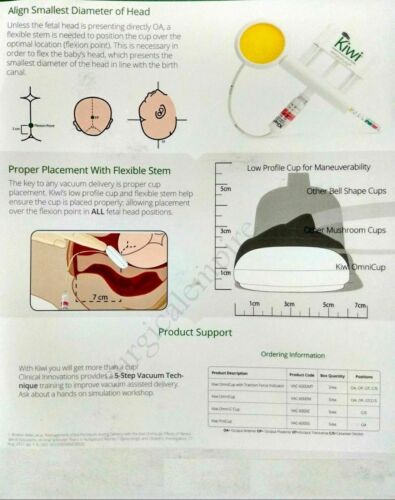
The Kiwi Complete Vacuum Delivery System — also known as the Kiwi ventouse or Kiwi vacuum extractor — is a disposable single-operator vacuum-assisted delivery device for use in obstetrics. The Kiwi vacuum delivery cup uses OmniCup flexible-stem technology and integrated PalmPump control to enable an obstetrician to perform vacuum extraction without a second operator managing the vacuum pump. It is indicated for assisted vaginal delivery in occiput anterior (OA), occiput posterior (OP), occiput transverse (OT), and compound fetal positions.
📘 Buying for a hospital or L&D unit? Read our Kiwi Vacuum Delivery System purchasing guide — clinical use, procurement, and L&D setup.
What is a Kiwi delivery system?
A Kiwi delivery system (also called Kiwi vacuum delivery, Kiwi ventouse, or Kiwi vacuum extractor) is a disposable ventouse device used during the second stage of labor to assist vaginal delivery. Unlike traditional metal or reusable silicone ventouse cups that require a separate suction pump and a second operator, the Kiwi vacuum delivery cup integrates a hand-held vacuum pump (PalmPump) into the device itself. The obstetrician can apply the cup to the fetal scalp, generate and monitor vacuum pressure, and complete traction with one hand — no assistant required to run the suction pump.
Kiwi vacuum vs. traditional metal ventouse cups
Traditional metal ventouse cups (Malmstrom-style) require a wall-mounted or portable electric vacuum pump and a second operator to manage suction. The Kiwi vacuum cup replaces that entire setup with a single disposable device. Key differences:
- Setup time: Kiwi = under 60 seconds. Traditional metal cup = 3-5 minutes to assemble tubing + pump.
- Staffing: Kiwi = one operator. Traditional = obstetrician + assistant running pump.
- Cross-contamination: Kiwi is single-use disposable. Traditional metal cups require full reprocessing between patients.
- Cup positioning: Kiwi OmniCup's flexible stem enables accurate placement over the flexion point in OP and OT positions where a rigid metal cup struggles.
- Fetal safety profile: Both devices have comparable neonatal outcome data when used per RCOG/ACOG guidelines. Kiwi's low cup profile is associated with reduced scalp marking in observational series.
Kiwi ventouse — step-by-step use
- Verify indications and prerequisites (full cervical dilatation, ruptured membranes, empty bladder, station at or below +2, known fetal position, consent, senior obstetrician available if needed)
- Prepare the Kiwi vacuum delivery system — open sterile package, inspect cup and PalmPump for defects
- Position the cup over the flexion point (~3 cm anterior to the posterior fontanelle in OA position; adjust for OP/OT). The Kiwi's flexible stem enables placement without rotating the maternal hand around the fetal head.
- Generate vacuum gradually using the PalmPump — reach 0.2 kg/cm² (150 mmHg), verify no maternal tissue entrapment, then increase to 0.8 kg/cm² (600 mmHg) for traction
- Apply traction synchronized with uterine contractions and maternal effort, in the axis of the pelvic curve
- Deliver the head — typically within 3 contractions/pulls; abandon if no descent after 3 pulls or 20 minutes total application
- Release vacuum after delivery of the head; dispose of the entire device per biohazard protocol
Clinical indications
- Prolonged or arrested second stage of labor with fetal head at or below +2 station
- Maternal exhaustion or inability to push effectively
- Maternal medical conditions where Valsalva is contraindicated (cardiac disease, cerebrovascular disease)
- Non-reassuring fetal heart rate patterns requiring expedited delivery when vaginal birth is imminent
- Second twin delivery when spontaneous delivery is delayed
Clinical specification
| Device type | Disposable vacuum-assisted delivery system (ventouse) |
| Cup design | OmniCup — low-profile flexible stem |
| Vacuum source | Integrated hand-held PalmPump |
| Vacuum range | 0-0.8 kg/cm² (0-600 mmHg) |
| Vacuum indicator | Green/yellow/red visual pressure zones on pump |
| Fetal positions | OA, OP, OT, compound |
| Sterility | Ethylene oxide sterilized, single-use |
| Regulatory | FDA cleared Class II obstetric device |
| Shelf life | 3 years from date of sterilization |
What's in the box
- One (1) Kiwi Complete Vacuum Delivery System with OmniCup
- Integrated PalmPump handle with visual vacuum indicator
- Sterile single-use packaging
- Instructions for use (IFU)
Frequently asked questions
What is the difference between Kiwi delivery and forceps delivery?
Both are operative vaginal delivery methods. Kiwi vacuum delivery applies suction traction to the fetal scalp via a cup; forceps use metal blades to grip the fetal head. Vacuum extraction (Kiwi) is associated with lower rates of maternal perineal trauma but higher rates of neonatal cephalohaematoma. RCOG and ACOG guidelines describe both as acceptable first-line options depending on operator training and clinical circumstance.
Is the Kiwi vacuum extractor single-use or reusable?
The Kiwi Complete Vacuum Delivery System is single-use disposable. Both the OmniCup and the integrated PalmPump are supplied sterile and are disposed of after one delivery. This eliminates the reprocessing burden and cross-contamination risk associated with traditional reusable metal ventouse cups.
What is the maximum vacuum pressure for Kiwi ventouse delivery?
The Kiwi PalmPump is calibrated to a maximum of 0.8 kg/cm² (600 mmHg). Traction pressure typically starts at 0.2 kg/cm² (150 mmHg) to seat the cup and verify no maternal tissue entrapment, then is increased to 0.6-0.8 kg/cm² for delivery traction synchronized with contractions.
Which fetal positions can Kiwi vacuum delivery be used for?
The Kiwi OmniCup flexible-stem design is validated for use in occiput anterior (OA), occiput posterior (OP), occiput transverse (OT), and compound fetal positions. The flexible stem enables placement over the flexion point without requiring the operator's hand to rotate around the fetal head — an advantage over rigid metal cups in OP/OT positions.
Is the Kiwi vacuum delivery system FDA cleared?
Yes. The Kiwi Complete Vacuum Delivery System is FDA cleared as a Class II obstetric device. It carries appropriate CE marking for European use as well.
How long can Kiwi be applied during vacuum-assisted delivery?
Standard obstetric guidance is to abandon the vacuum attempt if there is no fetal descent after three pulls with adequate traction, or if total cup application time exceeds 20 minutes. Cup detachment ("pop-off") more than twice is also an indication to abandon vacuum and consider alternative delivery.
Can Kiwi vacuum delivery be used for a second twin?
Yes. The Kiwi Complete Vacuum Delivery System can be used to assist delivery of a second twin when spontaneous delivery is delayed after delivery of the first twin. Standard prerequisites (full dilation, ruptured membranes, known position, consent) apply.
How is the Kiwi vacuum delivery system shipped?
Direct from our San Jose, California distribution center. Sterile single-use packaging inside a plain outer carton. Free US ground shipping with same-day dispatch on orders before 2 PM PT. For clinic bulk procurement contact clinic@scimedstore.com.
Also known as
Kiwi delivery system · Kiwi vacuum extractor · Kiwi ventouse · Kiwi OmniCup · Clinical Innovations Kiwi · disposable vacuum delivery cup · single-use ventouse
For obstetric practice, hospital labor & delivery procurement, or teaching-hospital training kit orders, contact clinic@scimedstore.com or (669) 265-9353.
Share