SciMed
Dynamic Cone Penetrometer (DCP) — Field Geotechnical Test Kit in Wooden Box, ASTM D6951
Dynamic Cone Penetrometer (DCP) — Field Geotechnical Test Kit in Wooden Box, ASTM D6951
Couldn't load pickup availability
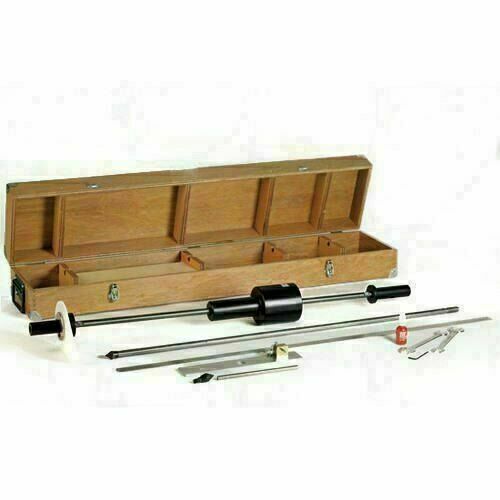
Dynamic Cone Penetrometer (DCP) — field-portable geotechnical instrument for rapid in-situ soil strength assessment. Measures pavement + subgrade + subbase soil strength by counting hammer blows required to drive the 60° cone tip through the soil layer. Results correlate to California Bearing Ratio (CBR), soil bearing capacity, and pavement compaction quality. ASTM D6951 / D7380 compliant. Standard 8 kg drop hammer with 575mm drop height, 20mm base diameter 60° cone tip, 1m graduated drive rod (extendable to 2m with optional extension). Complete wooden field carry box. $2,999 direct — for road construction, airport pavement, building foundation QC, and geotechnical consultancies.
Specifications
| Standard compliance | ASTM D6951 (Dynamic Cone Penetrometer for pavement) · ASTM D7380 (DCP for soil compaction) · UK TRL Report 175 |
|---|---|
| Drop hammer | 8 kg (17.6 lbs) — standard ASTM D6951 mass |
| Drop height | 575 mm (22.6") — standard fall distance |
| Cone tip | 60° apex angle, 20 mm base diameter, replaceable hardened steel |
| Drive rod | 1 m (39") graduated in mm and inches (extendable to 2m with extension rod option) |
| Anvil | Steel — 8 kg hammer strikes anvil, transferring energy to drive rod |
| Data output | Manual blow count logged with corresponding penetration depth (mm/blow = DCP Index) |
| Depth range | 0-1 m standard, extendable to 2 m with extension rod |
| CBR correlation range | Typically 1% to 100% CBR (site-dependent conversion via ASTM D6951 formulas) |
| Materials | Hardened stainless steel drive rod + hammer components, replaceable cone tip |
| Complete kit includes | Drop hammer + Anvil + Drive rod (1m) + Cone tip + Base plate + Wooden carrying box + Instruction manual |
| Weight | ~15-20 kg complete kit in wooden box |
| Warranty | 1-year parts + labor · Cone tip is consumable (~$45 replacement) |
How the DCP works
- Position DCP perpendicular to soil surface (use base plate for stability on soft surfaces)
- Record initial reading on the graduated drive rod (starting position)
- Lift the 8 kg hammer to the top of the drop rod (575 mm above the anvil)
- Release the hammer — free-fall onto the anvil drives the cone deeper into the soil
- Record the reading after every blow (or every 5-10 blows in soft soils)
- Continue driving until reaching target depth (typically 800mm for road subgrade)
- Calculate DCP Index = penetration depth (mm) per blow at each layer
- Convert to CBR using ASTM D6951 correlation: log(CBR) = 2.465 - 1.12 × log(DCP Index)
Applications
| Application | Typical DCP use |
|---|---|
| Road construction QC | Subgrade + subbase + base course compaction verification per station |
| Airport pavement | Runway + taxiway subgrade strength assessment (FAA + ICAO) |
| Building foundation | Pre-construction bearing capacity assessment, footing depth optimization |
| Highway maintenance | Pothole + rutting root-cause analysis, rehab prioritization |
| Landfill + embankment | Compacted fill quality verification |
| Pipeline + utility trenches | Backfill compaction verification |
| Rural roads + emerging market infrastructure | Low-cost pavement design + QC in developing regions |
| Forestry roads | Logging + skid road subgrade evaluation |
| Agricultural drainage | Soil compaction assessment for tile drainage design |
| Academic geotechnical teaching | University soil mechanics + pavement engineering labs |
Best for
- Highway construction contractors + subcontractors (state DOT + private road builders)
- Airport pavement construction + rehabilitation contractors
- Geotechnical consultancies + soil testing labs
- Municipal + state DOT quality assurance / quality control teams
- Building foundation contractors (pre-construction bearing assessment)
- Utility contractors — pipeline + trench backfill QC
- University civil engineering + geotechnical teaching programs
- Emerging market infrastructure development (India / Africa / LATAM road programs)
- Rural + forestry road builders
- Landfill + embankment construction QC
- Military engineering + expeditionary construction (SAM.gov procurement)
Buying for a DOT, geotechnical firm, or infrastructure contractor?
- Volume pricing on 5+ orders — DOT multi-crew QC teams, contractor fleet builds
- Net-30 invoicing for verified contractors, consultancies, universities, government
- SAM.gov / GSA / VA / DoD compliant procurement — Army Corps of Engineers, FAA, USACE
- ASTM + AASHTO documentation package included on request
- Extension rod option (+$300) — extends depth range to 2m for deep subgrade work
- Replacement cone tips ($45), hammer rods ($120), and drive rods ($180) stocked for 8+ years
- International DDP shipping — huge infrastructure market in India, Sub-Saharan Africa, LATAM, SE Asia
- Ocean freight for 5+ unit international orders
- Field-training documentation + video library included
FAQ
Does this meet ASTM D6951 specifications?
Yes — 8 kg drop hammer + 575 mm drop height + 60° cone tip + 20 mm base diameter all match ASTM D6951 standard. Test results are directly comparable to DCP data collected on Vertek, Kessler, or other ASTM D6951-compliant units.
How does DCP compare to laboratory CBR testing?
Lab CBR takes 3-4 days per sample ($200-500). DCP delivers equivalent CBR data in 15-30 min per test point (~$5-10 marginal cost). For QC applications requiring many test points across a construction site, DCP is 100× more cost-efficient. For final acceptance testing on critical structures, lab CBR remains gold standard.
What's the DCP Index → CBR conversion?
ASTM D6951 correlation: log(CBR) = 2.465 - 1.12 × log(DCP Index in mm/blow). Alternative Kleyn / Van Heerden formulas available for specific soil types. Convert both ways in the field with a simple slide rule (included) or spreadsheet.
What depth can I test to?
Standard 1m drive rod handles 0-1m depth (typical road QC needs 0-800mm). Extension rod option extends range to 2m for deep subgrade or building foundation work. Beyond 2m, use Standard Penetration Test (SPT) or Cone Penetration Test (CPT).
How long does one test take?
Typical 800mm road subgrade DCP test: 15-30 minutes including setup + hammering + logging. High-blow-count soils (dense granular base) take longer per depth increment; low-blow-count soft clays are faster. Two-person crew is standard — one hammers, one logs.
Is the cone tip replaceable?
Yes — hardened steel cone tip screws onto drive rod, replaces in field. Typical service life 500-2,000 tests before wear (depends on abrasive soil content). Replacement tips $45 stocked in San Jose.
How is this shipped internationally?
US: ground freight (~15-20 kg wooden box). International: DHL Express DDP or ocean freight DDP for 3+ unit orders. Ships to India, Sub-Saharan Africa, LATAM, MENA, SE Asia, GCC — huge infrastructure development markets where DCP is preferred for cost + speed vs lab CBR.
Share