SciMed
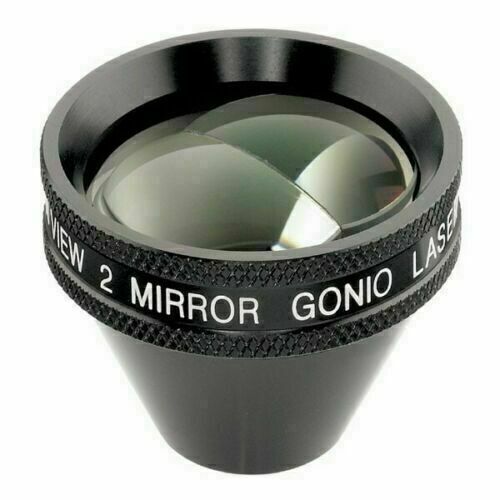
Aspheric 2-Mirror Gonioscope Lens — Anti-Reflection Coated, 62° Mirrors, 360° Angle View, Pediatric-Compatible
Aspheric 2-Mirror Gonioscope Lens — Anti-Reflection Coated, 62° Mirrors, 360° Angle View, Pediatric-Compatible
Couldn't load pickup availability
Aspheric 2-mirror gonioscope lens for anterior chamber angle examination in glaucoma diagnostics + surgical planning. Two opposing mirrors inclined at 62° provide complete 360° view of the drainage angle with only 90° of lens rotation (vs 360° rotation required by single-mirror gonio lenses). Small contact surface makes it usable in children and adults with narrow palpebral fissures where 3-mirror + 4-mirror lenses don't fit. Precision-crafted glass with anti-reflection coating. Includes protective case. $99.99 direct — versus $250-$450 for Volk G-2 / Ocular OG2M / Ocular Latina M-2 branded equivalents. Free shipping.
Applications
- Glaucoma diagnosis — open vs closed angle differentiation (fundamental to POAG vs PACG workup)
- Angle grading — Shaffer / Van Herick correlation, Spaeth grading
- Pigment dispersion syndrome — TM pigmentation assessment
- Pseudoexfoliation syndrome — PXF material on TM + Sampaolesi's line
- Angle recession assessment — post-trauma angle evaluation
- Neovascular glaucoma — angle NV detection
- Preoperative SLT / MIGS planning — trabecular meshwork visualization prior to selective laser trabeculoplasty or MIGS (iStent, Hydrus, Kahook)
- Pediatric glaucoma — small contact footprint fits infant + small pediatric eyes where 4-mirror won't seat
- Small palpebral fissure adults — East Asian anatomy, ptosis patients, blepharospasm
Specifications
| Type | Aspheric 2-mirror indirect gonioscope lens (Goldmann-style contact lens) |
|---|---|
| Mirror configuration | 2 opposing mirrors inclined at 62° from optical axis |
| Coverage | 360° angle view with 90° lens rotation (vs 360° rotation for 1-mirror) |
| Material | Optical glass with anti-reflection multi-layer coating (reduces reflections + improves contrast) |
| Contact | Requires coupling gel (methylcellulose 2% or hypromellose GonakⓇ-equivalent) |
| Contact surface | Small footprint — accommodates pediatric eyes + adults with narrow fissures |
| Sterilization | Cold sterilization (10-min soak in EPA-approved high-level disinfectant) or wipe-clean with alcohol |
| Storage | Included hard protective case with foam insert |
Comparison to Volk / Ocular gonio lenses
| Feature | SciMed 2-Mirror | Volk G-2 (2-mirror) | Ocular OG2M | Zeiss 4-mirror |
|---|---|---|---|---|
| Mirror config | 2 × 62° | 2 × 64° | 2 × 62° | 4 × 64° (dynamic) |
| Rotation for 360° | 90° | 90° | 90° | None (dynamic) |
| Coupling gel required | Yes | Yes | Yes | No (dry contact) |
| Pediatric-usable | Yes (small) | Yes | Yes | No (large flange) |
| Price | $99.99 | $275 | $310 | $385 |
Best for
- Glaucoma specialists + comprehensive ophthalmologists (essential gonio lens)
- Optometry practices with glaucoma management scope
- Ophthalmology residents + optometry students (training lens)
- Community + rural eye clinics (cost-effective glaucoma workup)
- International eye NGOs — Aravind, LV Prasad, Fred Hollows, Sightsavers, ORBIS
- Teaching hospitals with pediatric ophthalmology (small contact fits infant eyes)
Buying for a practice, residency program, or eye NGO?
- Volume pricing on 3+ lenses (residency training + multi-provider practice)
- Net-30 invoicing for verified practices + academic + NGO accounts
- SAM.gov / VA compliant for federal ophthalmology
- Bundle discounts on gonio + BIO lens sets (20D/28D/78D/90D combinations)
- International DDP — global eye NGO + academic ophthalmology procurement
FAQ
2-mirror vs 4-mirror gonio — which do I need?
Both, ideally. 4-mirror (Zeiss / Sussman) uses dry contact and can perform indentation gonioscopy (differentiates appositional vs synechial angle closure). 2-mirror (this lens) requires coupling gel but has smaller contact area and works in pediatric eyes and narrow fissures where 4-mirror can't seat. Comprehensive practices carry both. For residency training + solo glaucoma clinic, this 2-mirror is the essential first lens.
Coupling gel compatibility?
Standard 2% methylcellulose (Goniosol, Gonak, generic hypromellose 2.5%). Compatible with all commercial gonio coupling gels. NOT compatible with saline (too runny) or standard ophthalmic viscoelastic (too thick).
How does the 90° rotation work?
Two mirrors at 62° positioned opposite each other. First view: superior + inferior angles simultaneously. Rotate lens 90°: now see nasal + temporal angles. Total 90° rotation → full 360° coverage. Single-mirror lenses require full 360° rotation to cover the angle — much slower.
Sterilization protocol?
Between patients: 10-min immersion in EPA-approved high-level disinfectant (Cidex OPA, hydrogen peroxide 3%) OR wipe with 70% alcohol. Do NOT autoclave (heat destroys AR coating + delaminates glass). Store dry in included case between uses.
Share